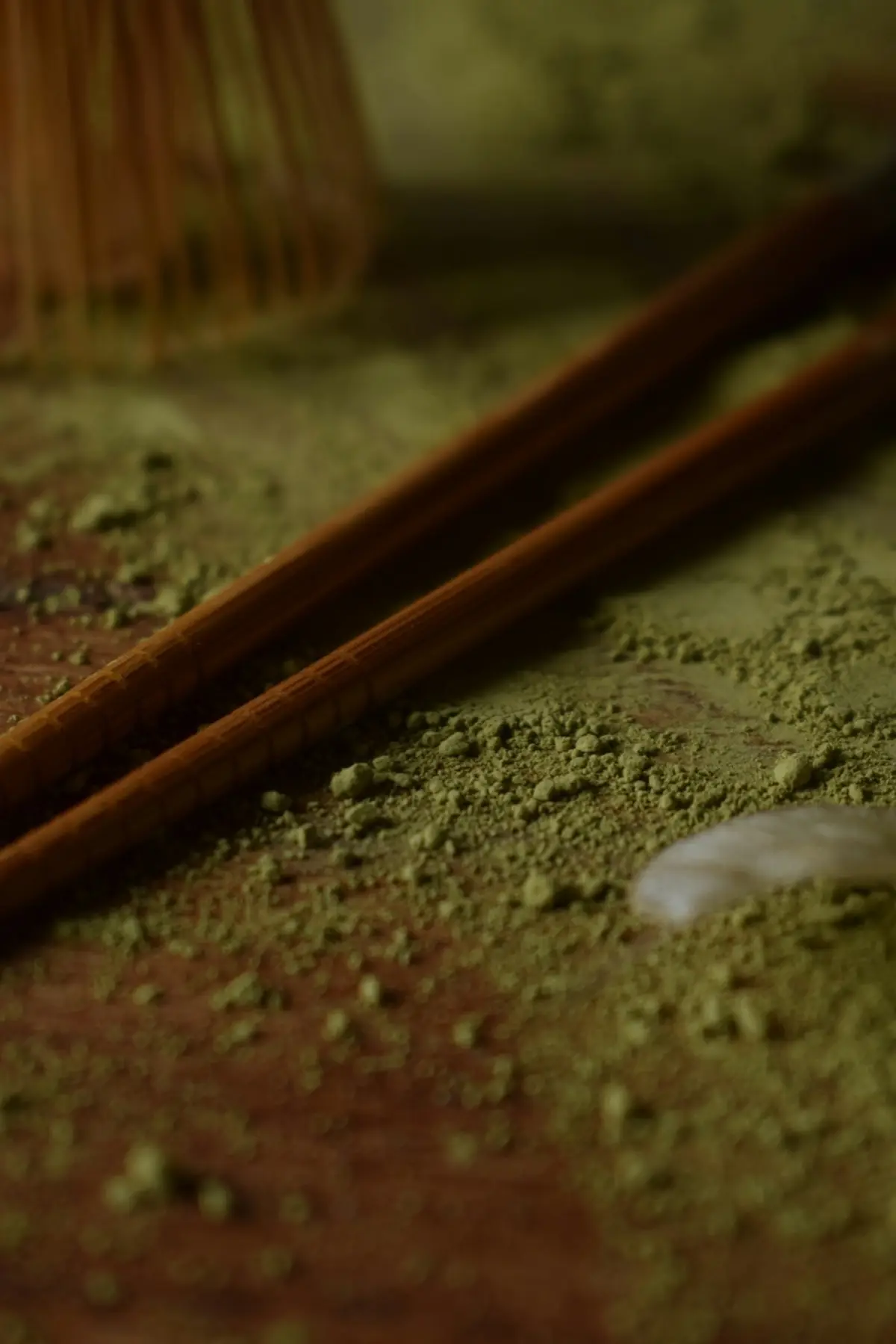
What actually happens to matcha over time
Matcha does not spoil in the way that milk spoils. It is a dry powder, and dry powders do not readily grow anything. What it does is fade.
The colour goes first, and it goes for a specific reason. The jade green of fresh matcha is chlorophyll. Chlorophyll holds a magnesium ion at the centre of its molecule, and heat, light, acidity and time knock that ion out and replace it with hydrogen. The result is pheophytin, which is the same molecule minus its magnesium and is olive-brown instead of green. That single reaction is why old matcha looks like dried herbs.
The flavour follows the same curve for different reasons. A 2020 study in Food Science and Biotechnology stored matcha at a range of temperatures and measured what happened: catechin content, total phenolics, antioxidant activity, brightness and green value all declined as storage temperature and storage time rose. Nothing about that is surprising. What is useful is the direction and the fact that it is measurable in months rather than years.
Sweetness leaves before bitterness does, which is the cruel part. An old tin does not become mildly less good in every direction. It loses the delicate half of its flavour and keeps the harsh half, so it reads as much worse than the measurements suggest. If a tin you liked has turned sharp, read the bitterness causes — but check the colour first.
Matcha shelf life, in numbers you can plan around
- Unopened, cool and dark: roughly a year before the loss becomes obvious.
- Unopened, refrigerated or frozen: longer, and this is what Japanese producers do with their own stock.
- Opened: four to six weeks of good drinking. It stays perfectly usable for months afterwards; it stops being worth what you paid for it.
Reaction rates in food chemistry roughly double for every 10 °C of extra storage temperature, as a rule of thumb rather than a law. A tin on a sunny counter at 25 °C is ageing at something like twice the rate of the same tin at 15 °C, and several times the rate of one in a fridge. That is the entire case for cold storage, and it is a good case.
Should matcha be refrigerated? Mostly, with one rule
For unopened tins you are keeping more than a month, refrigerate them. For the tin you are drinking from, the answer depends on whether you can follow one rule.
Let it come back to room temperature before you open it. Cold powder in a warm kitchen pulls condensation out of the air onto itself. Matcha is hygroscopic — it takes up moisture readily — and moisture is worse for it than warmth. Wet powder clumps hard, and clumped powder is on its way to musty.
So: take the sealed tin out, leave it on the counter for half an hour, then open it. If that is more discipline than your mornings can support, keep the working tin in a cupboard away from the stove and the window, and refrigerate only the backup.
Everything else about storage is the same short list. Airtight, opaque, cool, dry, away from the hob. Do not decant matcha into a clear jar on a shelf, however good it looks.
Reading the colour instead of the date
The best-before date on a tin of matcha is close to useless, because it is set from when the powder was packed, and packing can happen many months after milling. Tencha is stored as leaf and ground to order by careful producers, and ground long in advance by careless ones. Nothing on the label distinguishes the two.
Colour does. Tip a little dry powder onto a white plate in daylight:
- Vivid, slightly yellow-toned jade — fresh, well shaded, recently ground.
- Flat mid-green — either later harvest or a few months past its best.
- Olive, khaki or brown-tinged — old, or badly shaded, or both. This tin will be bitter and thin whatever you do to it.
Smell is the second check. Fresh matcha smells sweet and slightly marine. Old matcha smells of hay, and then of fish. Musty means moisture got in, and that tin goes in the bin rather than into a latte.
The same colour test is one of the checks in how to spot fake matcha, for the good reason that stale matcha and cheap matcha look alike in the tin.
Can you use expired matcha? Yes, downwards
Faded matcha is not wasted matcha, it is demoted matcha. It has lost the qualities you drink it plain for, and kept enough colour and bite to survive under milk or in baking.
Put it in a latte with oat milk and a little syrup — the latte method works with anything — or into cookies, ice cream, or a smoothie, where sugar and fat do the covering. What it should not be used for is a bowl of usucha, and it should certainly not be the tin you judge a producer by.
The way to not have this problem is to buy less at a time. A 30 g tin at one bowl a day is a fortnight. A 100 g bag is cheaper per gram and, for most households, a slow, quiet loss — which is why the per-gram column in the buying guide is a starting point and not the whole answer. Two small tins usually beat one large one, and what matcha actually is explains why this powder is so much more fragile than the leaf tea it came from.